

You are cordially invited to a lecture within the module Paleobiology and Sedimentary Geology, to be delivered by a visiting lecturer from Rey Juan Carlos University, currently hosted at the Postgraduate School ZRC SAZU as part of the Erasmus+ mobility programme Assoc. Prof. Ángela Fraguas Herráez, PhD:
Tiny fossils, big stories: what calcareous nannofossils reveal about past oceans, climates and high-energy events.
Calcareous nannofossils are a cornerstone in both precise rock dating and the reconstruction of past oceanographic conditions and climatic changes. Their abundance, global distribution, rapid evolutionary rates, and excellent preservation make them powerful biostratigraphic markers, while their sensitivity to environmental variations provides key insights into past changes in temperature, productivity, salinity, and ocean chemistry.
This lecture presents case studies from the Lower Jurassic of Spain that highlight the remarkable potential of these microscopic fossils. Biostratigraphic events, particularly the first occurrence of index species, allow high-resolution correlations and refined chronologies, even where other fossil groups are scarce. At the same time, shifts in calcareous nannofossil assemblages reflect the response of marine ecosystems to major environmental perturbations, including global warming episodes, linked to extinction events, and the Toarcian Oceanic Anoxic Event, through changes in species abundance and size.
By integrating biostratigraphic and paleoenvironmental approaches, this talk demonstrates how calcareous nannofossils provide essential tools to unravel ocean dynamics, climatic changes, and high-impact events in Earth history, showing that tiny fossils can tell remarkably big stories. The lecture concludes with an outlook on a new research project investigating the presence of microfossils, such as nannofossils or diatoms, in coastal deposits from Atacama (Chile), in order to confirm their potential (paleo-)tsunamigenic origin and expanding the application of microfossils to the study of extreme depositional processes.
The lecture will be held in English on Wednesday, 27 May 2026 at 4:00 PM in the Gosposka Hall of ZM GIAM ZRC SAZU, Gosposka ulica 16, Ljubljana.
Ángela Fraguas is an Associate Professor of Geology at Rey Juan Carlos University (Spain). Her research focuses on both biostratigraphy and the response of calcareous nannoplankton to global environmental and climatic changes from the Late Triassic to the present. She holds a PhD in Geology from Complutense University of Madrid that received the Extraordinary Award for Best PhD Thesis. She has wide international experience, including a postdoctoral position at Goethe University Frankfurt, Germany, and research stays at the Natural History Museum, London, UK, and the University of Milan, Italy. She has authored over 25 peer-reviewed international publications, many in top-ranked journals, and has contributed extensively to conferences and to international, national, and regional research projects. She currently teaches a range of courses related to Geology and Paleontology in Biology, Environmental Sciences, and Experimental Sciences at the undergraduate level. She is actively involved in outreach activities and in educational Innovation projects that adapt contents of geology field practices to students with motor and hearing disabilities.
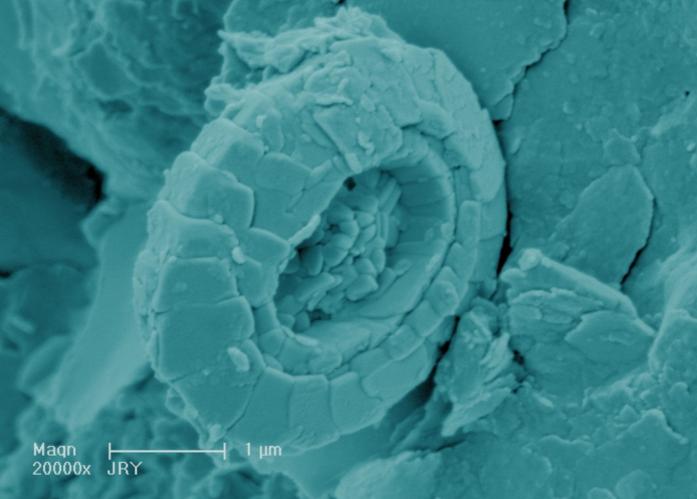
Photo: Lotharingius sigillatus by Ángela Fraguas Herráez