

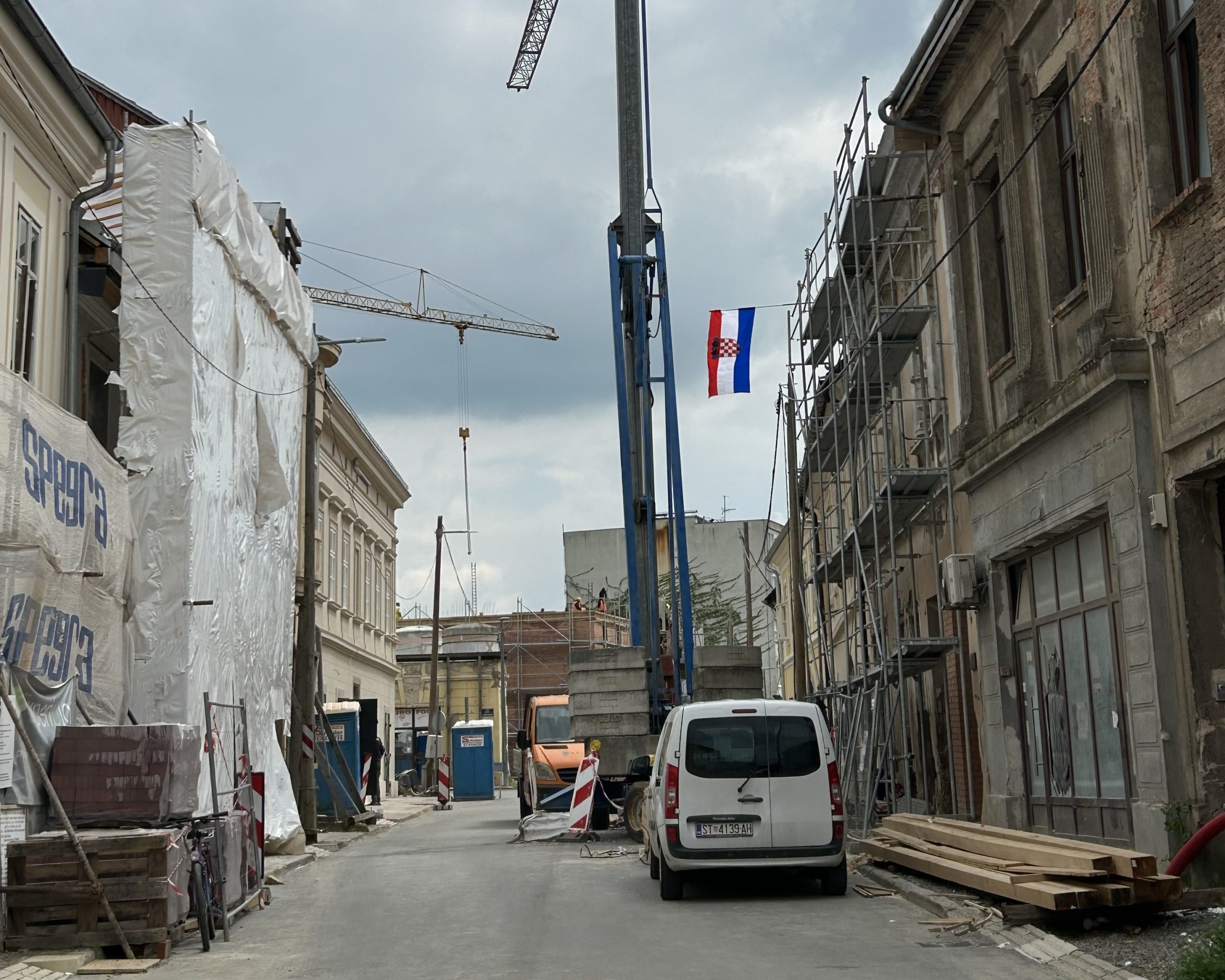
We invite you to a guest lecture organised as part of the doctoral module Cultural History by the Postgraduate School ZRC SAZU and the Institute of Culture and Memory Studies ZRC SAZU.
Tamara Banjeglav, PhD, research associate at the Institute for Cultural and Memory Studies, ZRC SAZU:
Slow Violence and the Politics of Time: Delayed Reconstruction after the Petrinja Earthquake
A 6.4-magnitude earthquake struck central Croatia in December 2020, with its epicentre near the town of Petrinja, marking one of the most devastating natural disasters in the country’s recent history. While the initial event was sudden and highly visible — triggering emergency responses, media attention and government promises of rapid recovery — this presentation argues that the disaster cannot be understood only through its immediate material destruction. Rather, it is argued that delayed reconstruction, damaged infrastructure, bureaucratic obstacles, and institutional neglect have transformed time itself into a mechanism of violence. Drawing on Rob Nixon’s concept of “slow violence,” the presentation conceptualizes post-earthquake recovery as a temporally extended process in which harm unfolds gradually and often invisibly. In this context, waiting is not a neutral condition but a politically produced experience that exacerbates inequality and uncertainty.
The presentation attempts to answer the following research questions: how does slow violence manifest in the extended recovery process following the 2020 Petrinja earthquake? In what ways do bureaucratic delay, social neglect, and uneven reconstruction contribute to ongoing harm and injustice? By foregrounding the politics of time, the analysis shows that the effects of disaster persist not only in ruined buildings but in the protracted and uneven processes of rebuilding, through which vulnerability is reproduced rather than resolved.
The lecture will be held in English on Wednesday, April 8, 2026, at 1:00 p.m. in the library of the Institute for Cultural and Memory Studies ZRC SAZU, Trg francoske revolucije 7, 2nd floor, Ljubljana.
Tamara Banjeglav is a research associate at the Institute of Culture and Memory Studies at the Research Centre of the Slovenian Academy of Sciences and Arts. She holds the Marie Skłodowska-Curie Actions ERA fellowship, in the framework of which she is conducting research on the project “Time is (not) on my side: Remembering victims of slow violence in a post-conflict and post-disaster setting”. She has received her PhD degree from the University of Graz, Austria. Her research interests fall within the fields of memory studies, peace and conflict studies, nationalism studies, and transitional justice, particularly in the post-Yugoslav space.
Photo: Tamara Banjeglav