

The Institute of Philosophy of ZRC SAZU, in cooperation with the doctoral programme Comparative Studies of Ideas and Cultures at the Postgraduate School ZRC SAZU (module: Transformations of Modern Thought – Philosophy, Psychoanalysis, Culture),
cordially invites you to two guest lectures by Matteo Cosci, Associate Professor of the History of Philosophy at the Department of Philosophy and Cultural Heritage, Ca’ Foscari University of Venice.
Monday, 16 February, and Tuesday, 17 February
Two Lectures on Galileo
Both lectures will take place at 12:00 am in the Gosposka Hall of ZM GIAM ZRC SAZU (Gosposka ulica 16, Ljubljana) and will be held in English.
In the first lecture, he will discuss the significance of Galileo’s reflections on the “new light” (Kepler’s nova) that appeared in the sky in 1604 for his Copernican cosmology. The full significance of this discovery can be understood through a comprehensive analysis of Galileo’s scattered studies on the nova and the study of the works of his opponents. In his lecture, he will refer to various sources (teaching notes, reports, selected quotations, letters, marginalia, etc.). These documents of Galileo can be classified as pieces of the puzzle of an unusual and consistent view of the nova that “de-fixed” the fixed stars. The framework of Galileo’s studies of the nova was the Copernicus heliocentric hypothesis, which he sought to confirm by studying this phenomenon.
In his second lecture, he will present the attribution process that has led him to the acknowledgement of Galileo as the author of the treatise entitled Considerazioni d’Alimberto Mauri on the nova of 1604 (Florence, 1606). He will argue that the confirmed attribution allows to reassess the subsequent technological and optical development of the design of the Dutch telescope. Moreover, a hypothesis for the decodification of the pseudonym, an overview of the references of choice, and the overall relevance of the neglected treatise on the “new star” can be accordingly discussed. In conclusion, it is possible to identify the Considerazioni as the promised treatise on the new star by Galileo and the missing bridge to the Sidereus Nuncius.
An outline of the findings to be presented in the lectures is available here.
—
Matteo Cosci is associate professor of History of Philosophy at the Department of Philosophy and Cultural Heritage at Ca’ Foscari University of Venice, where he is also head of the degree program in “Philosophy, International Studies, and Economics”. Cosci studied at the University of Padua and at the King’s College London, spending research periods in Oxford and in the United States. His academic research focuses mainly on Aristotle, the history of Paduan Aristotelianism, and Galileo Galilei. Besides various contributions and articles on these topics, he is the author of the monograph Truth and comparison in Aristotle (2014), a couple of co-edited collections on the history of syllogism (Bloomsbury, 2018 and 2023), and a forthcoming book on Franz Brentano’s logic. Cosci is member of several national and international scientific societies and member of the editorial boards of academic journals such as Philosophical Readings in Lexis. At Ca’ Foscari Cosci has collaborated in two recent ERC research projects, on Renaissance Vernacular Aristotelianism and Early Modern Cosmology respectively. Cosci has recently concluded a Marie Curie research fellowship on the topic of the so-called Kepler supernova, with a project under the title of “The Ophiuchus Supernova: Post-Aristotelian Stargazing in the European Context”. In this framework he is currently editing and translating several works on that specific astronomical event. Among these, a special place is occupied by the study of the pseudonymous Considerazioni d’Alimberto Mauri (Florence, 1606), in regard of which Cosci has retrieved new evidence in favour of its re-attribution to Galileo.
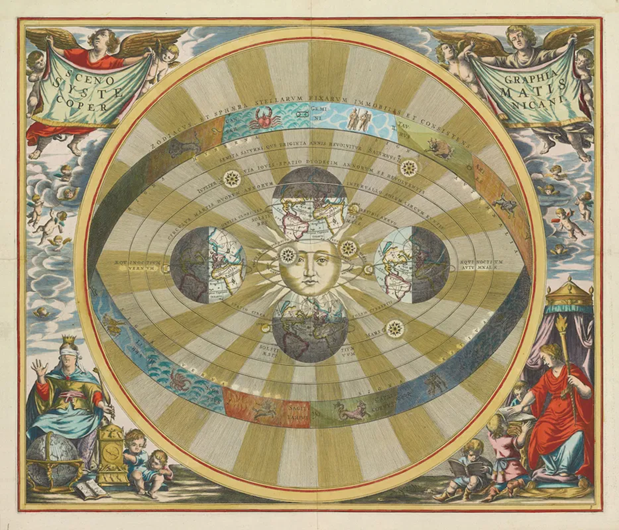
Photo: Copernican System of the Universe, Andreas Cellarius, 1660, From Harmonia Macrocosmica – Public Domain Image Archive